Tuesday, March 8, 2011

#NoOfficeDay Reflections, Take Aways, and Questions...

Reading through David Truss's Blog, I came across a wonderful post alluding to his venture into a #noofficeday.  This along with other lively discussions as well as entertaining creative discussions alluding to classroom observations made me decide it was time to try it for myself.   

I do spend the better half of most days in classrooms, but with over 35 classrooms most of the days I simply get a "snapshot" of each room.  Even on this day, although I did get to many of the classrooms, I did not make it to each one.  This was fine though, my key rationale for the day was to "GET INVOLVED" and to "SEE WHAT A DAY IS LIKE IN OUR CLASSROOMS."

My key reflective question I had going into the day was:

Are our students truly engaged?  Are they active in their learning process?  Do they truly UNDERSTAND the material?

    When I first arrived at St. Annies 4 years ago, I saw a building full of incredibly bright students.  They were fantastic "traditional" students who could take knowledge that they were taught, study it, digest it, and then regurgitate it when asked.

    HOWEVER, when we began to focus more on critical thinking and the WHY? behind everything, I saw students hesitate and all of a sudden become deer in headlights...
    What I saw during my #noofficeday was progress... Our students are more engaged, they are not performing mundane tasks, they are becoming LEARNERS... 

    So it was good to see progress in these areas, is there still room for improvement?  Obviously...  We are not there yet, but we are moving in the right direction. because if you are not moving forward, then you are moving backward...


    Wednesday, February 23, 2011

    Catholic Guilt and Cursive

    I am glad to see there's been a lot of talk about cursive writing and the place it has in today's classroom. Handwriting, to say it mildly, was always my weak point (Highest grn ade I ever received for it was an I aka. improvement needed...).


    I did receive numerous negative comments on my writing throughout my educational career and I managed to graduate high school, an undergraduate degree in elementary education and a graduate degree in educational leadership.  All with awful handwriting.

    My first job was at a Catholic School in Philadelphia (In the Year 2000) run by a wonderful Sister of the Immaculate Heart who to this day I still fell in debt to since she took a chance on me when I was a 21 year old rookie looking for a job.

    To prove I was worthy of this position, I was going to develop the best weekly lesson plans she had ever seen.  I spent a lot of time writing them and was proud when I sent my plan book on Monday morning to the principal to be checked over. 


    Before my  next breath, Sister was on my loud speaker asking me to come see her.  My heart dropped, what could I have done wrong?

    "What is this?!" (in a way only a nun can say it)...

    "My lesson plans Sister" (in my most timid voice)

    "Why are they in RED PEN and why is it not in CURSIVE?!"

    "Ummmm.... I thought Red pen looked nice and I can't really write cursive."

    "YOU CAN'T WRITE CURSIVE!!!???"

    "No Sister" (Head down, true Catholic guilt setting in)

    "Well I guess you have some learning to do!"

    Not the best first interaction with my principal, but I figured it could be worse. (It did the following week when I ended up losing my car with all of my teacher manuals )

    So for the following weeks, each week the plans were handed in, black pen, cursive and all.  Yet again I got the dreaded call down to the office about a month later.

    "Okay Brad you win.  My eyes are tired and frankly I'm giving in.  How would you like to write your plans?"

    "I would love if I could type them and then print them out for you each week.  That way you can read them and I am a much better typer than I am at cursive."

    "Fine"

    "Thank you Sister."

    I won that battle but when Sister came to observe me, let's just say my handwriting on the board didn't meet her approval.... (This is before we had projectors and a computer hooked up to it with a smartboard etc...)

    So what's the point of cursive?

    Being a Catholic School Principal today, there is still a high priority that many teachers and parents place on good handwriting.  It is still part of the guidelines and curriculum.  It is still a grade on kids in the primary grades report cards.  Parents do still challenge teachers about their child's handwriting grade.

    It pains me that this has to be a part of our school.  It's not that I believe it should be completely abolished, but the focus has to change.  I agree with the people who ask "what is being taken out due to handwriting instruction?"

    The majority of school districts and private schools usually state somewhere in their mission/vision about "preparing students to compete in a global economy and become 21st century learners who critically think, collaborate, and communicate."

    DOES CURSIVE PREPARE THEM FOR THE GLOBAL ECONOMY OR IS IT A 21ST CENTURY SKILL???

    I know I have my opinion...

    Monday, February 7, 2011

    Motivation... If We Understand It Better, How Can We Lead People To Their Passion?

    Since I was around ten years old I knew my passion was education, I think it began while I was helping my Dad coach my 6-year old brother's soccer team.  The same motivation I was trying to instill in the 6 year olds to play better soccer, I now strive to do with my faculty... That being said, although they may seem like 2 completely different scenarios, I believe more and more that the MOTIVATION, be it of 6 year olds or professional adults are not that dissimilar.

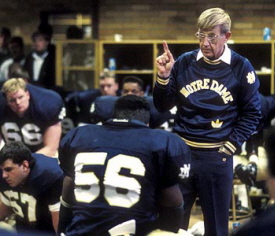
    Being a big sports nut and ex-coach (I retired :)) many leadership books written by coaches truly resonate with me.  Being an avid Notre Dame fan, one of the first books I picked up in terms of "leadership" is a book by Lou Holtz: Wins, Losses, and Lessons...


    What Coach Holtz addresses and hits upon better than most is his on-going quest to find different passions and more importantly, the idea of being part of something much bigger than yourself.  His emphasis on leading others to their passion and finding what motivates not only his players, but his assistant coaches, is something that should resonate with all educational leaders.

    Holtz on Passion:

    "As far as a passion is concerned, everybody needs four things in life: everybody needs something to do, someone to love, something to hope for, and something to believe in. You have to have those four things."

    Holtz says "you can pay people to perform, but you can't pay them to excel".

    How do you get your faculty and staff to excel? Does the need or want to excel come from themselves, or can we, as leaders, draw that out of people?

    In closing....


    "...You can delete people that aren't motivated, but if somebody is not motivated, it is simply because [he or she does not] have any goals or aspirations. The reason so many people do not aspire for greatness is because they do not know how good they can be, or they are afraid of failure, or afraid that they may not reach it. Your job as a coach is to show people how good they can be, and get them to think in terms of getting better in different areas of their life. The trust, the commitment, and the care certainly help. Just getting people to have something they want to accomplish with their life [is vital]. Then, show them how they can do it."-from leadernetwork.org


    YOU GOTTA BELIEVE!!!

    Friday, October 29, 2010

    What's easier: Breaking into Fort Knox or Logging onto your Facebook account at school? (Firewalls and why we don't need them in schools)

    During an administrative Elluminate session on Wednesday the topic came up regarding the firewall that prevents some schools to not have access to specific sites.  Personally I taught in two different schools (one Catholic, one Charter) both of which DID NOT have a firewall.

    I did teach middle grades in both schools, I had 2 classroom computers in my one and six in the other.  Over the course of seven years, I had only ONE incident where a student used the computer inappropriately, and, in reality, it wasn't even a major issue.

    Did kids go on sites they shouldn't have been in ever?  I can honestly say I doubt it.  Why and how?

    1. GROUND RULES WERE SET... "Free" time (if there ever was any) students were allowed to go on one of five sites that were bookmarked already for them under "Fun".  They included sites that were deemed fun by the students, but also APPROPRIATE.
     
    2. When the technology was being used, IT WAS MONITORED...  Too often I believe the "problems" associated with an open network stems from a lack of teacher involvement and monitoring...  The teacher needs to make the norms of the classroom by both modeling and setting the expectations from Day One.
     
    3. THEY WERE EDUCATED...  From parental handouts, to a separate "web safety" section of the monthly newsletter, to the technology and classroom teacher STRESSING "netiquette", to the D.A.'s office coming in warning of the dangers, to a bunch of other events...

    IT EVENTUALLY BECAME THE "NORM" OF THE SCHOOL....


    The web should not be treated like Fort Knox, it should be treated as a resource that is invaluable for both student and teacher use, but there needs to be an education piece that goes along with the use of it.  Recently I was in a school that had You Tube blocked.  A resource as valuable as this should never be blocked.  At this same school, web 2.0 tools such as wallwisher.com, edmodo.com, and wordle.net were also blocked.  How can we expect our teachers to explore and learn when everywhere they look there is a big


    Tuesday, October 5, 2010

    Homework? My Dog Ate It...

    Homework.  Kids hate it and Parents (at least of elementary students) aren't big fans either.  The problem that I continue to see though is not that homework is necessarily a bad, evil, thing...

    The problem is the lack of understanding of what MEANINGFUL homework looks like.  The lack of student ownership on many homework assignments is a start as to looking what is wrong.  The old paradigm or pointless, rote, worthless homework is now shifting to the new Homework Paradigm that includes the designing of quality homework tasks that include:


    • Academic Purpose - tasks should have a clear academic purpose
    • Competence - tasks should have a positive effect on a student's sense of competence
    • Ownership - tasks should be personally relevant and customized to promote ownership
    • Aesthetics - tasks should be aesthetically pleasing (Vatterott, 2009)
    This leads to student ownership of homework.  The groundwork for all teachers homework assignments should include:
    • Allow for choice
    • Offer students an opportunity to personalize their work
    • Allow students to share information about themselves and their lives
    • Tap emotions, feelings, or opinions about a subject
    • Allow students to create products or presentations (Vatterott, 2009)
     Examples that look like:

    • Students design their own method for learning multiplication tables that they then share with others - making cards, writing, reading, drawing pictures, or creating a song, rap, or poem.
    • Students write a story or newspaper article showing that they know the meaning of the 15 vocabulary words for the week
    • Students create a Jeopardy! game that covers the main ideas at the end of the unit
    • Students write directions that can be used by other students for how to use a balance beam
    • Students create a board game that signifies events of the middle ages (Vatterott, 2007)
    What are your thoughts and your school's philosophy on homework?  Is everyone on the same page?  What has worked for your schools?

    Monday, April 26, 2010

    The Leadership of Early America...


    I began watching the History Channel Series, America: The Story of Us Sunday night and I highly recommend it to every educator, or history buff. As I watched the episode though, I found numerous principles of leadership reoccurring throughout the show. George Washington named Baron Von Steuben, an elite soldier from the Prussian Army who's career was supposedly over due to his homosexuality makes him a top commander. Washington placed people in positions to be successful and they were. An effective leader places people in positions to be successful and, when given the support, encouragement, and training needed, good things generally happen and in turn facilitative leadership occurs. Without strong leadership and training, the American Revolution would never have occurred.

    John Rolfe (Pure Genius & America's Original Entrepreneur)

    1. Obtain some tobacco seeds from South America
    2. Marry the Powhatan Chief's hot daughter to gain friendships with the Native Americans
    3. Plant your seeds and work with the Powhatan to learn about farming
    4. A year later you are a millionaire and thousands come to the New World seeing that prosperity can be had there

    Communication

    The communications system throughout the colonies during this time was more effective than I ever realized. Without it, there would have been no independence of Great Britain. This was done thanks in large part because of the first Postmaster General, Mr. Benjamin Franklin and his organizational leadership skills. One of the first things I dedicated myself to as principal was to make sure that effective communication lines were open between the students, teachers, and parents. During my internship as an aspiring principal I saw


    Collaboration

    During the first continental congress, the idea of a United Colonies, came forth. "An attack on one of the colonies, is an attack on us all." The leadership of each of the colonies saw the importance of coming together as one and this was the only way something can be accomplished. Collaboration in education, now more than ever is vital for the prosperity of our children. As educators we must come together and ensure that our students are recieiving a 21st century education  grounded in collaboration, critical thinking, and creativity.  


    Quotes from first Episode REBELS... (Various celebrities and academia alike comment throughout the show, definitely enjoyable to hear their take)

    When someone is really successful it is rarely luck.  It's talent, it's brainpower, etc... - Donald Trump

    The defining strength in America is it's people. - Colin Powell